
How to Make a Marketing Plan: A Step-by-Step Guide With a Worked Example
Most businesses in Saudi Arabia do not lack marketing activity. They post, boost, run a promotion before Ramadan, try an influencer. What they lack is a plan that connects those activities to one goal and tells them, after three months, whether it worked. This guide walks through the seven parts of a practical marketing plan, in the order we build them for clients, and ends with a worked example you can adapt. At the end you can download a free one-page marketing plan template, in English and Arabic.
What a marketing plan is (and what it is not)
A marketing plan is a short document that answers five questions: where the business is now, who it is trying to reach, what it is offering them, how it will reach them, and how it will know it is working. It is not a content calendar, a list of platforms or a logo refresh. Those come later, and they come out of the plan.
A useful plan for a small or mid-sized Saudi business fits on six to ten pages. If it is longer, nobody reads it after the first meeting.
Step 1: Start with an honest situation analysis (SWOT)
Before choosing channels, write down where the business actually stands. The SWOT format still works because it forces you to separate what you control from what you do not.
• Strengths — what you do better than nearby competitors: location, product quality, delivery speed, price, reputation, a team that speaks to customers well.
• Weaknesses — what is costing you customers today: a slow website, no reviews on Google Maps, a menu or catalogue that has not been photographed properly, no one answering WhatsApp after 10 pm.
• Opportunities — what is changing in your favour: a new district opening near you, a season (Ramadan, Eid, summer, Riyadh or Jeddah Season, back to school), a competitor that has gone quiet, a platform where your audience is growing.
• Threats — what could take customers away: a new branch of a bigger brand, rising ad costs, delivery-app commission, a regulation affecting how you can advertise.
Keep each list to three to five points. The goal is not to be complete; it is to find the two or three facts that will shape every decision after this.
Step 2: Choose one main objective and a number to judge it by
"Grow the brand" is not an objective. A usable objective names a result and a deadline: more orders, more booked appointments, more qualified leads, more store visits.
Then attach a measurable key result to it. For example:
• Increase online orders from the website from X to Y per month by the end of the quarter.
• Bring 40 qualified real-estate enquiries per month at under a set cost per lead.
• Reach page one on Google for three service-plus-city searches within six months.
Use your own baseline numbers. If you do not have them yet, the first month of the plan is spent installing tracking so you do.
Step 3: Define your audiences (segments)
Most Saudi businesses sell to more than one type of customer, and each needs a different message. Write a short profile for two to four segments:
• Who they are — age range, city or district, language preference (Arabic, English or both), family or business buyer.
• What they need — the problem they want solved, and what makes them hesitate.
• Where they look — Snapchat and TikTok skew younger, Instagram is strong for visual products, X is used for news and opinion, LinkedIn for B2B, Google for anyone ready to buy, and WhatsApp is where the conversation usually closes.
A primary segment gets most of the budget. A secondary segment gets a smaller, separate campaign.
Step 4: Set the marketing mix (the 4Ps)
The 4Ps are old, but they stop a plan from being only about advertising.
• Product — what exactly are you selling, and what is the one reason to choose it? If you cannot say it in one sentence, the ads will not either.
• Price — where you sit against competitors, and whether you will use offers. Constant discounts train customers to wait for the next one.
• Place — where customers buy: your branch, your website, Salla or Zid, delivery apps, distributors. Every channel you advertise must lead to a place where buying is easy.
• Promotion — the channels and messages, which is the next step.
Step 5: Pick channels by objective, not by habit
Match each objective to the channels that serve it:
People already searching for what you sell: Google Ads, SEO, Google Business Profile.
Creating demand for something new: Snapchat, TikTok, Instagram, influencers.
Leads for high-value services or property: Google Search, Meta lead campaigns, landing pages, WhatsApp.
Repeat purchases: Remarketing, WhatsApp broadcasts, email.
Two or three channels done properly beat six done halfway. See paid advertising and SEO for how we run each.
Step 6: Set a budget and a test period
Split the budget into two parts: most of it on what is already known to work, and a smaller share on tests (a new audience, a new creative format, a new platform). Give paid campaigns two to four weeks before judging them, and SEO and content three to six months. Changing everything after one week means you never learn what worked.
Remember that ad spend and production are separate costs. Our pricing page lists starting prices for management, content and websites.
Step 7: Decide how you will measure and report
Before the first riyal is spent, agree on:
• The numbers that matter — orders, enquiries, bookings, cost per result, return on ad spend. Reach and likes are supporting numbers, not results.
• Where they come from — ad platform dashboards, Google Analytics, the store or booking system, and the CRM or WhatsApp log.
• When you review — a short weekly check and a monthly review where you decide what to stop, what to scale and what to test next.
Worked example: a specialty coffee roaster in Jeddah
This is an illustrative example, not a client case study. The numbers are placeholders to show the structure.
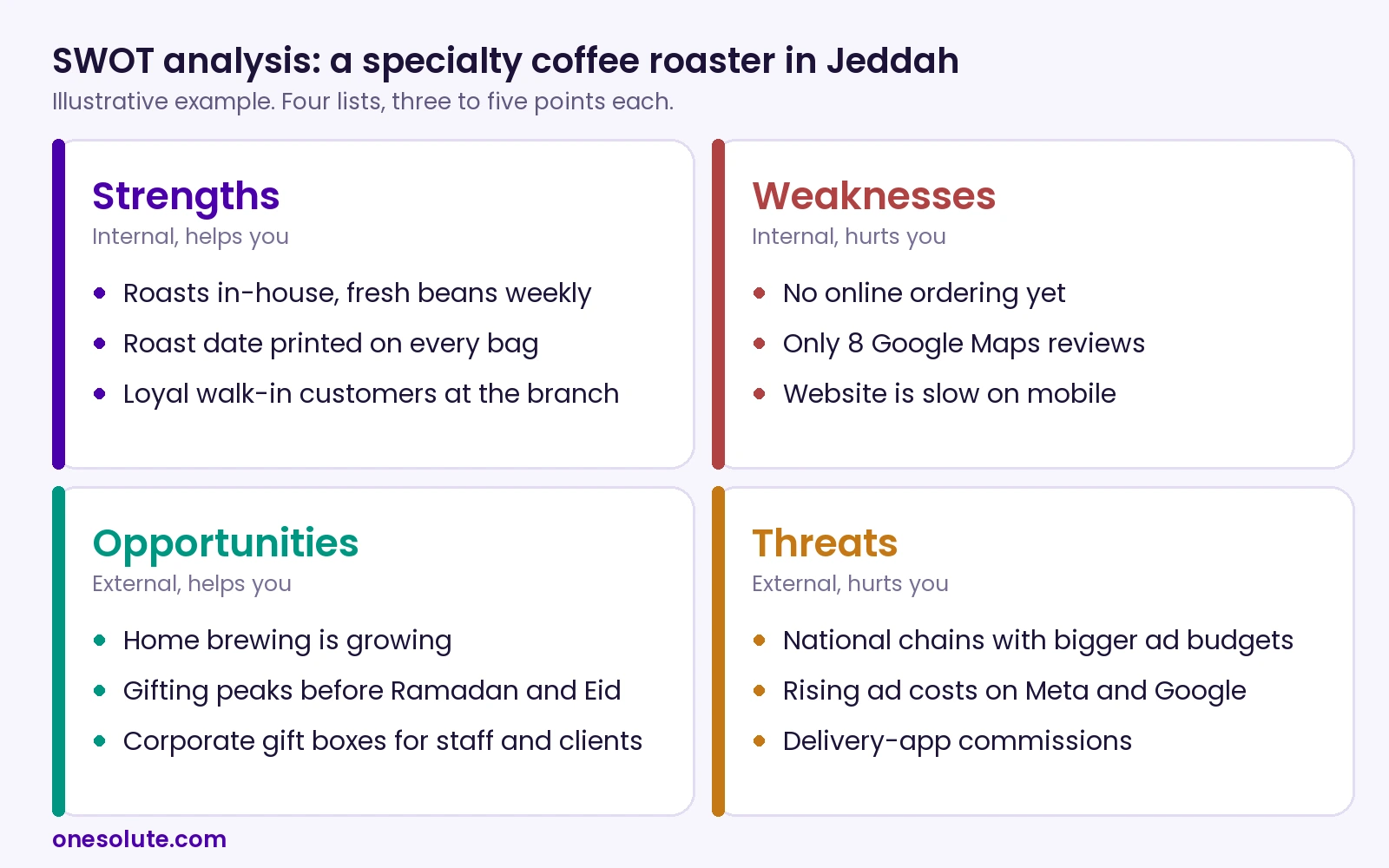
Situation (SWOT). Strength: roasts in-house and sells fresh beans, which supermarkets cannot match. Weakness: website has no online ordering; Google Maps listing has eight reviews. Opportunity: home brewing is growing, and gifting peaks before Ramadan and Eid. Threat: national chains with larger ad budgets.
Objective. Launch online ordering and reach a set number of web orders per month within one quarter, with a target cost per order.
Segments. Primary: home brewers aged 22–40 in Jeddah who buy beans monthly. Secondary: companies buying gift boxes for staff and clients before Ramadan.
4Ps. Product: fresh beans roasted weekly, with roast date on every bag. Price: premium, no permanent discounts; a first-order offer only. Place: new online store with same-day delivery in Jeddah, plus the branch. Promotion: below.
Channels. Instagram and TikTok for brewing content and product video; Google Search and Google Business Profile for "coffee beans Jeddah" type searches; remarketing to store visitors; a separate LinkedIn and WhatsApp outreach for corporate gifting six weeks before Ramadan.
Budget and tests. Most of the ad budget on Instagram and Google Search; a smaller test budget on TikTok. Review at week four.
Measurement. Web orders, cost per order and repeat-order rate from the store dashboard; corporate enquiries logged from WhatsApp. Monthly review decides where the next month's budget goes.
The same structure works in any sector; only the audiences, channels and seasons change. See how we apply it for restaurants and cafés, clinics, real estate, online stores and education providers.
Free download: a one-page marketing plan template
Put the seven steps on one page. The template has a box for each part of the plan: SWOT, objective and key result, audiences, the 4Ps, channels and budget, and how you will measure and review it. Print it or fill it in on screen, and keep it to one page.
If you would rather have the plan built with you, our marketing strategy service starts from this same structure.
Common mistakes
• Choosing channels before the objective.
• Running ads to a website that cannot take orders or bookings.
• Judging SEO after one month, or paid ads after one week.
• Reporting likes and reach instead of orders and leads.
• Writing a plan nobody updates after the first month.
Frequently asked questions about marketing plans
Where to go next
Start with the free template above and fill in step one this week. If you would like help turning it into a plan with a budget and numbers to judge it by, see our marketing strategy service or the starting prices on our pricing page.
Ready to Start? Let Us Look at Where You Are First
Book a free 30-minute consultation. We will review your website, your accounts and your current campaigns, and give you a candid opinion on your growth priorities — whether or not you work with us.